4 key trends shaping graduate business enrollment in 2026
At a recent gathering of business school deans at our Washington, DC headquarters, one theme came up again and again: the graduate business market is entering a new phase. Student affordability concerns are rising, AI is reshaping how prospective students discover and compare programs, and international demand is becoming more volatile year to year. Classes that would typically be set by now are still taking shape.
Below are four key trends influencing graduate business enrollment in 2026 and what schools can do to stabilize gaps in top-of-funnel interest with right-fit leads.
Trend 1: Prospective graduate business students are increasingly price sensitive.
Demand for business programs remains uneven. While application rates have risen 25% over the past five years, enrollments have declined 6%. If your lead volume, number of inquiries, or yield are down, students’ shifting enrollment decision drivers are likely part of the reason.
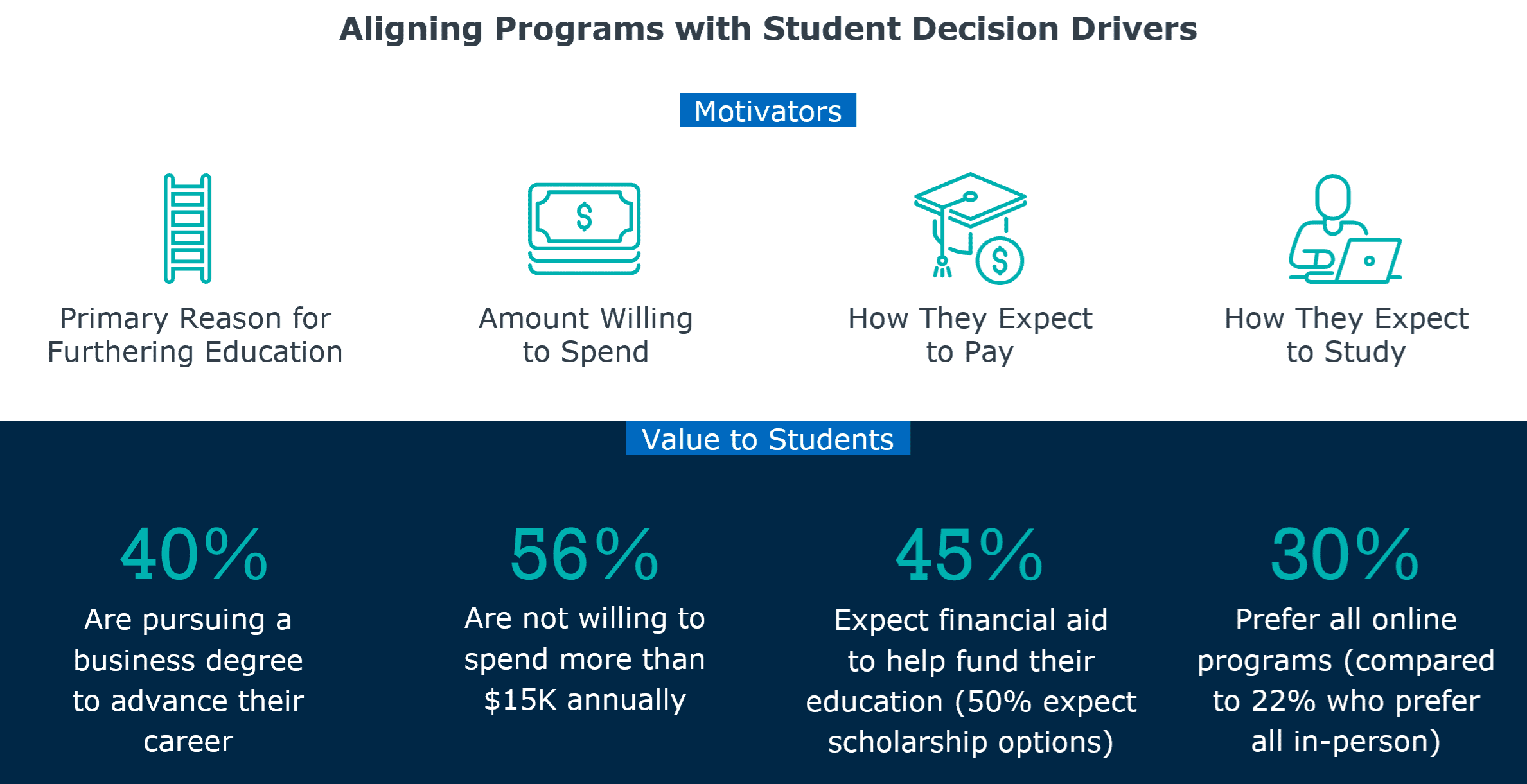
Cost has long been a deciding factor in prospective students’ choices. But we’ve entered a new era of extreme cost-consciousness. According to EAB’s latest survey of more than 8,000 graduate and adult learners, 64% of prospective business students said cost was the top factor that would lead them to remove a school from consideration. At the same time, 45% expect financial aid and 50% anticipate receiving scholarships to fund their education.
Policy and financing changes may intensify this pressure. With the elimination of funding options such as Grad PLUS and stricter borrowing limits, more applicants may abandon the enrollment process later in the cycle as aid packages are finalized.
Here’s what you can do:
- Present program cost clearly and transparently on your website, including tuition, financial aid, and scholarship opportunities, so prospects can quickly understand affordability.
- Reevaluate aid and pricing strategies to help bridge affordability gaps as borrowing limits tighten and funding options evolve.
- Leverage high-intent lead sources such as Appily Advance to reach qualified prospects and help offset enrollment gaps caused by late-cycle melt.
- Differentiate your value proposition around ROI and career outcomes, aligning messaging with the decision drivers that matter most to cost-conscious students.
Trend 2: Grad business candidates shop stealthily—and AI is amplifying the shift.
More than half (56%) of today’s business prospects prefer to “stealth shop,” researching programs independently before sharing personal information. In fact, more than a quarter say they won’t share their contact information with schools until they are ready to apply.
AI is accelerating this behavior. Twenty-one percent of prospective business candidates are already using AI tools such as ChatGPT or Google’s AI Overviews to research and compare programs. As discovery increasingly happens through search and AI-assisted tools, high-interest stealth shoppers risk missing programs that fail to surface across these channels.
Once a prospect does shortlist your program, your web content becomes even more critical. Ninety-four percent of students will visit a school’s .edu site before applying. And when they arrive, they expect an experience that feels relevant and personalized to their goals. Schools that invest in targeted, full-funnel enrollment marketing see stronger engagement, particularly among business candidates who respond well to personalized messaging.
Here’s what you can do:
- Diversify your lead generation strategy to reach stealth shoppers earlier in their research process.
- Refine nurture strategies to deliver tailored messages about program value and career outcomes at key moments in the decision process.
- Optimize your .edu for both traditional and AI-driven search. Conduct a search visibility audit to identify gaps in discoverability and content relevance.
Trend 3: Prospective students increasingly expect proof of career ROI.
As graduate business candidates become more focused on cost, they are also scrutinizing the financial and career outcomes of an advanced degree more closely. Many enter the decision process with prior professional experience and clear expectations for career mobility.
In fact, 40% of prospective business students say they are pursuing a graduate degree to advance their career, while 32% are primarily motivated by increasing earning potential. These candidates are not just evaluating program features; they are assessing whether a degree will deliver tangible professional returns.
Programs that clearly demonstrate real-world outcomes have a competitive advantage. Highlighting social proof such as alumni success stories, industry partnerships, networking opportunities, and hands-on training experiences can help illustrate the career pathways and professional mobility students can achieve through your program.
Here’s what you can do:
- Identify students, alumni, and industry partners who can share tangible outcomes tied to your programs.
- Lead with outcomes-focused messaging that highlights labor market demand, career pathways, and salary potential.
- Centralize ROI information on your website and keep it regularly updated so prospects can easily evaluate program value.
Trend 4: Graduate business prospects are applying to fewer programs—and deciding faster.
Graduate business candidates are becoming more selective in how they search and apply. Domestic students, in particular, are narrowing their shortlists and moving more quickly through the decision process. On average, they apply to just 3.64 programs, compared to 6.08 for international students, and are more likely to complete their search within six months. With limited attention and fewer applications, programs have a smaller window to influence decisions and convert interest into enrollment.
At the same time, broader market dynamics are intensifying competition. International students have historically made up a significant share of graduate business enrollment, accounting for 36% of enrollments in fall 2024. Now, political shifts and tighter border policies are reducing that pipeline, contributing to a 17% drop in new international enrollments in fall 2025. That represents a potential $3B revenue loss from international graduate enrollment for U.S. institutions in just one year. And while domestic applications rose 4.9% in 2025, it wasn’t enough to offset the 3.4% decline in international applications.
As a result, more institutions are competing for a smaller, more selective domestic applicant pool. Highly selective universities are expanding their reach into domestic markets, while national “online giants” such as University of Phoenix or WGU continue to invest heavily in digital advertising—some spending as much as $196 million annually. By comparison, traditional nonprofit institutions reported an average total marketing budget of $4.15 million in the 2025-26 academic year.
How EAB helps institutions diversify and strengthen domestic lead generation strategy
Here’s what you can do:
- Expand your pipeline with targeted domestic lead sources. Enrollment partner platforms like Appily Advance can help you reach qualified prospects earlier in their search and connect with students who match your ideal program profile.
- Align your SEO, GEO, and paid strategies with domestic student behavior and decision drivers so your programs appear where high-intent prospects are actively researching options.
- Prioritize high-intent leads—those most likely to convert—to focus recruitment efforts where they matter most.
Diversify your approach to lead generation
To stay competitive in an evolving landscape, graduate business leaders must strengthen their enrollment and lead-generation strategies to maintain a steady flow of student demand. Yet managing lead acquisition across multiple platforms can be complex and costly.
Solutions such as Appily Advance help business programs generate high-intent leads at scale through a consolidated approach. In fact, Appily Advance leads deliver a 15% higher response rate than traditional test-taker lists, helping programs drive more right-fit enrollments. Request a demo to learn how Appily Advance can help strengthen your graduate business pipeline.
Ready to get started?
Speak with an expert to learn more about how Appily Advance can help find and nurture graduate business leads.

The high cost of low-quality graduate leads

Marketing teams are stretched thin. Here’s what the data says to do next.

Related Resources

Business candidates want personalized marketing from you—here’s how to do it well
More Blogs

The higher ed SEO checklist

Marketing teams are stretched thin. Here’s what the data says to do next.