Students are keeping their college options open longer. Here’s how to stand out.
There’s a certain kind of restaurant where the menu is so long, you get paralyzed. Rice bowls, salads, pizza, burgers, and tacos, all on the same page. Everything sounds fine, but nothing really stands out. Ironically, more choices often don’t help you find what you want; they make it harder to pick.
Today’s high school students are in a similar quandary.
Students are comparing more college options than ever during their senior year, and as their consideration sets grow, it becomes harder to differentiate between potential paths or commit to any one of them.
Our latest First-Year Experience Survey, drawing on responses from more than 9,500 students, puts fresh data behind that phenomenon.
Students continue to apply to more schools
The survey findings show that application proliferation continues to intensify across senior year, building on a trend we’ve been tracking for years. In our sample of college-bound high school students, the average number of applications per student has steadily increased, rising from 6.1 to 7.1 over the past four years, with admits following a similar upward path.
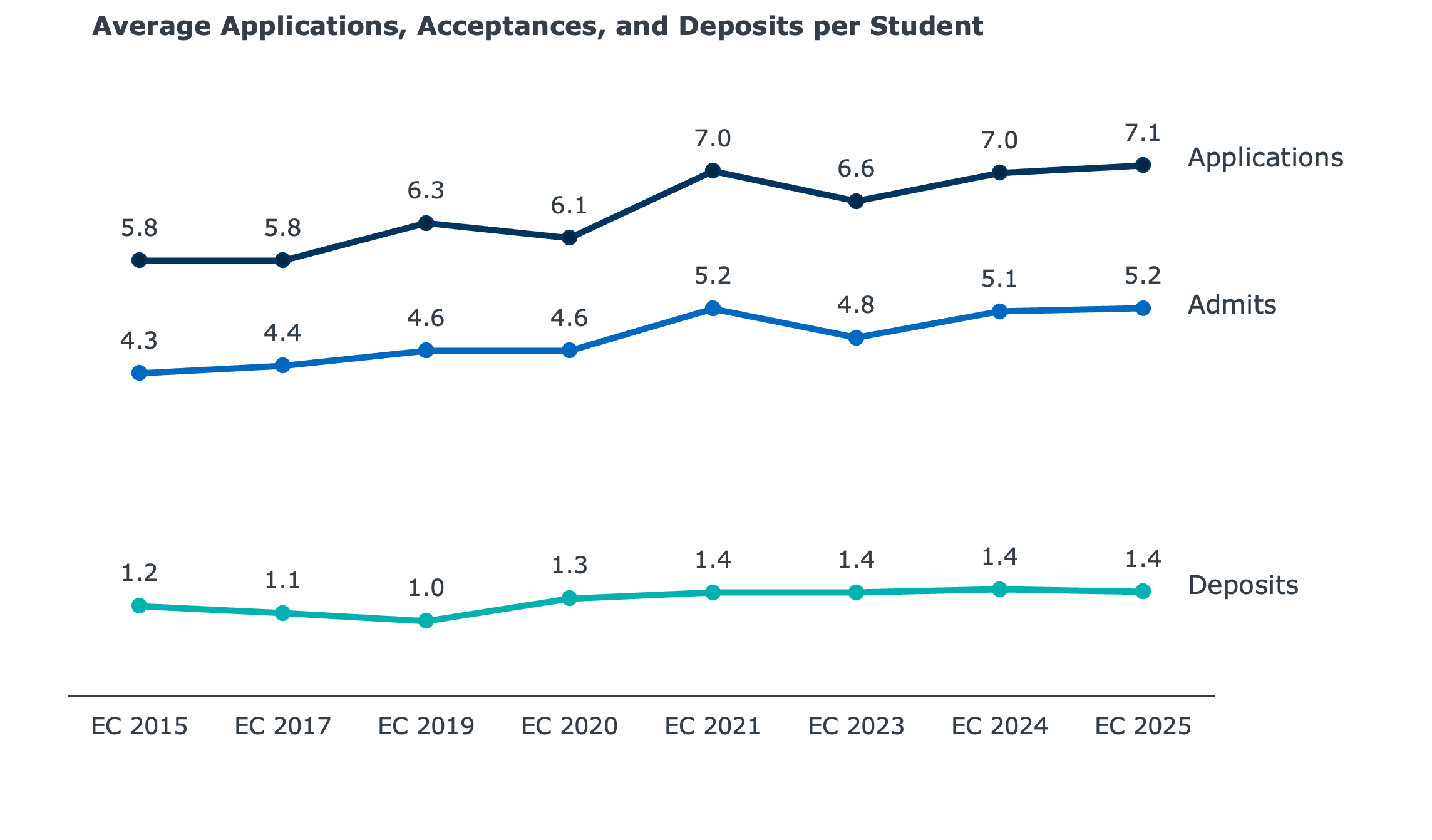
The data also illustrates a few areas where this trend is most marked.
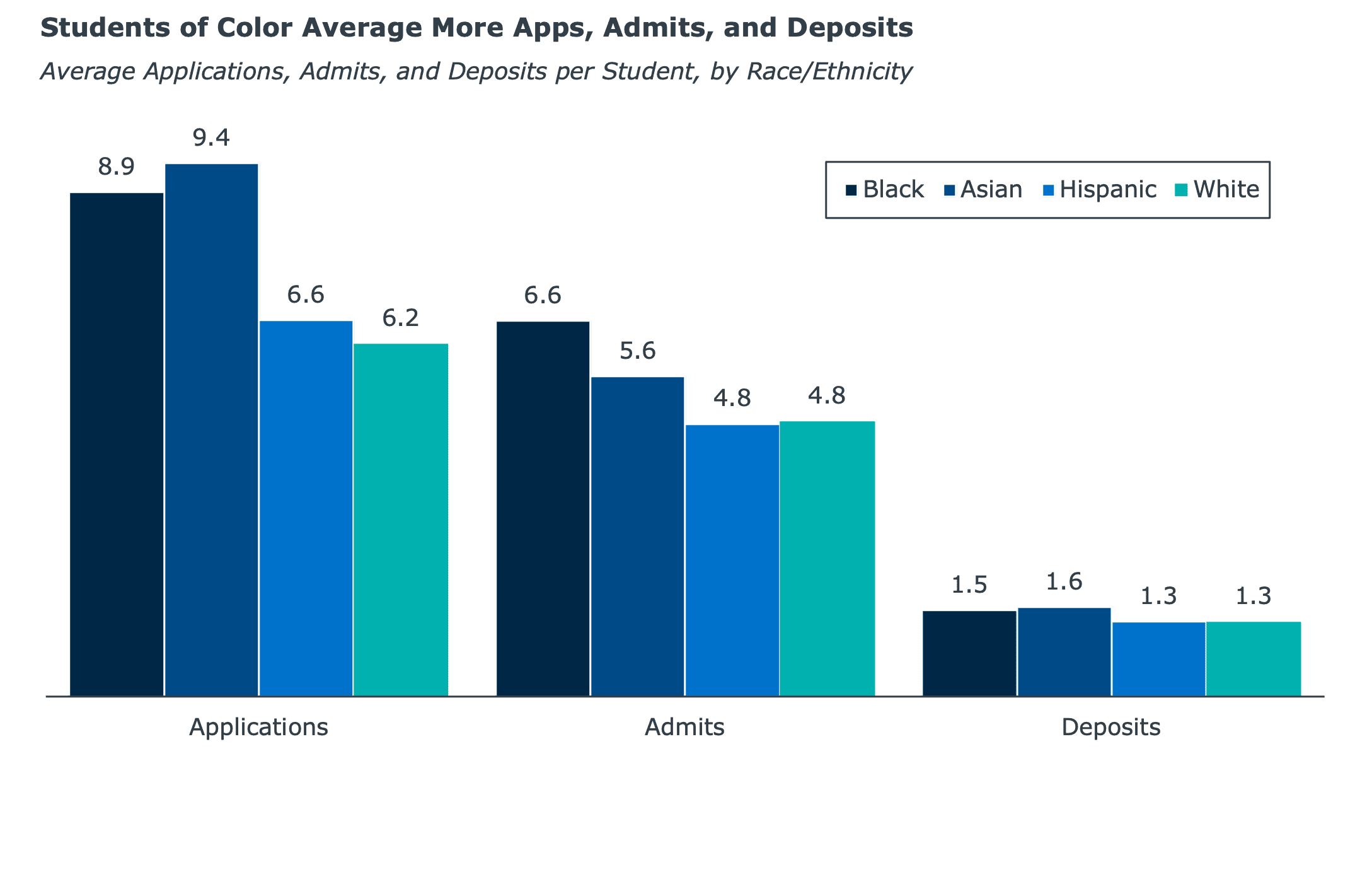
Students of color submit more applications, receive more admission offers, and submit more deposits than White students.
We see a similar pattern among higher-income students. Those from households earning more than $120,000 annually submit more applications and average 1.5 deposits, reflecting the financial flexibility to pay to hold multiple seats.
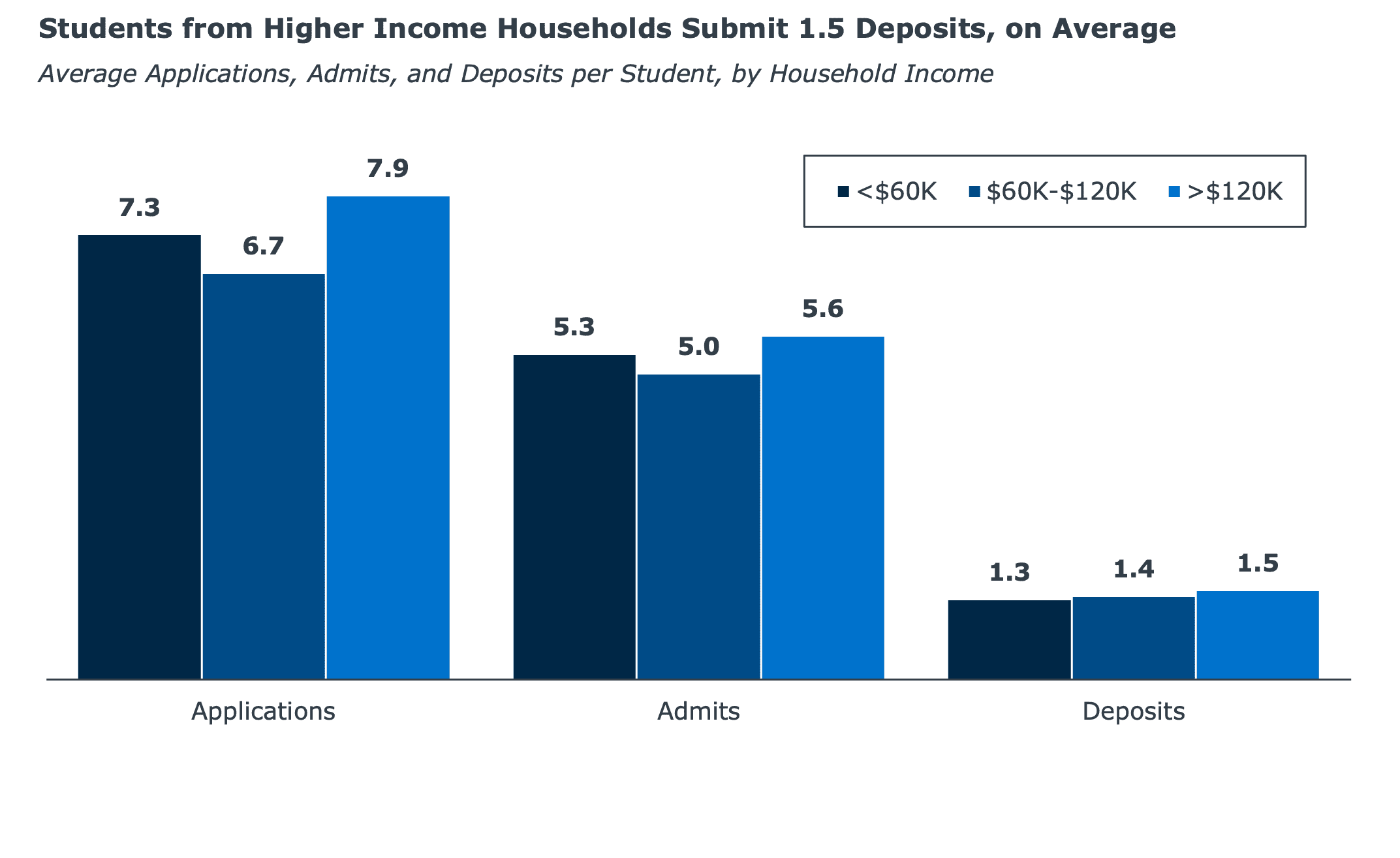
Looking across this data, it’s clear that competition is becoming more prolonged, and often most intense for the students who institutions can least afford to lose.
Not your father’s enrollment funnel
If students are applying to more schools and keeping more options in play, deeper into the cycle, there are at least two immediate implications for colleges:
- Enrollment marketers need to capture attention and grow affinity across the entire arc of the senior year.
- An application or an admit alone is no longer as strong a signal of student intent as it once was.
As someone who spends a lot of time developing enrollment marketing strategies with our partners, it’s clear that most traditional prospective student engagement approaches weren’t built for a world where stiff competition continues all the way through senior year.
How marketing must adapt, during and before senior year
In this choice-rich environment, incremental changes to the marketing approaches of yesteryear won’t be enough. Here are three principles my team and I have been returning to as we refine campaigns and strategies with our partners:
1. Reach and engage families early.
If you want to compete for applications and deposits, you need to start earlier than you think. EAB data shows a clear first-mover advantage. Students first contacted as freshmen are 2.3x more likely to apply and 2.4x more likely to deposit than those first contacted in senior year.
Just as important, outreach can’t stop with students. Parents remain the single most influential voice in the college decision process, especially on financial considerations. When parents are meaningfully engaged, students are 53% more likely to apply and 20% more likely to enroll.
That means building parent engagement strategies that start early, span the full funnel, and focus on the topics that matter most, including affordability, safety, and career outcomes.
2. Move from a transactional engagement approach to one that prioritizes continuous nurturing.
Many enrollment strategies still concentrate effort around a handful of moments, including application deadlines, admissions decision communications, and yield events.
That model is increasingly out of sync with student behavior. Today’s students are making decisions over a longer window and revisiting their options repeatedly. It requires a more continuous approach, one that nurtures students throughout senior year rather than ramping up only at key milestones.
At EAB, we are enhancing our senior-year marketing approaches to build sustained engagement streams that do more than drive applications. Enrollment marketing needs to deepen affinity and actively support decision-making at each stage of the process.
3. Personalize interactions at scale.
Student expectations for engagement are rising quickly.
In fact, our survey findings showed a slight decline this year in the share of students who named direct communications from colleges as one of the most helpful key resources in their search. One likely reason is that as students adopt AI tools, they’re becoming accustomed to faster, more tailored, and more direct answers.
However, that doesn’t make college communications less important, with sixty-eight percent of students still saying they prefer to hear from colleges via email early in their search. But it does raise the bar for what “helpful” means.
To keep pace, institutions need to deliver personalization at scale. That includes exploring more responsive, AI-enabled interactions that can meet students with timely, relevant information when and how they’re searching. The goal is to communicate with greater precision and usefulness throughout the decision journey. And to be effective, it’s important to use purpose-built agents for yield and other uses so that students get the specific information they need.
Students are applying to more schools, meaning they’re staying in the market longer. The institutions that recognize that shift and adapt early will have a clear advantage when decisions are made.

More Blogs

The enrollment game has changed. What still works?

How mature is your AI search strategy?