How enrollment leaders are using AI—and where the biggest opportunities still exist
Just a few years ago, many graduate enrollment teams were only beginning to experiment with AI—or were avoiding it altogether. Our annual surveys with NAGAP, The Association for Graduate Enrollment Management, shows how quickly that has changed. In 2023, 25% of surveyed graduate enrollment leaders had never used AI. Now, that number is just 5%.
But while AI adoption is growing, many enrollment teams are still figuring out how to use AI strategically and where the biggest opportunities lie. Here are three key findings about how graduate enrollment teams are using AI—and the challenges it presents—based on our latest surveys.
1. Fewer than half of respondents are using AI to support marketing and enrollment
Despite AI’s rapid proliferation into our work and personal lives, not all institutions are using AI in their marketing and enrollment efforts—yet. Only 42% of respondents report that their school is using AI to support graduate enrollment marketing. Respondents are most often using AI to power chatbots, create content, and manage marketing campaign strategy. The vast majority (95%) use ChatGPT, followed by Microsoft Copilot (46%).
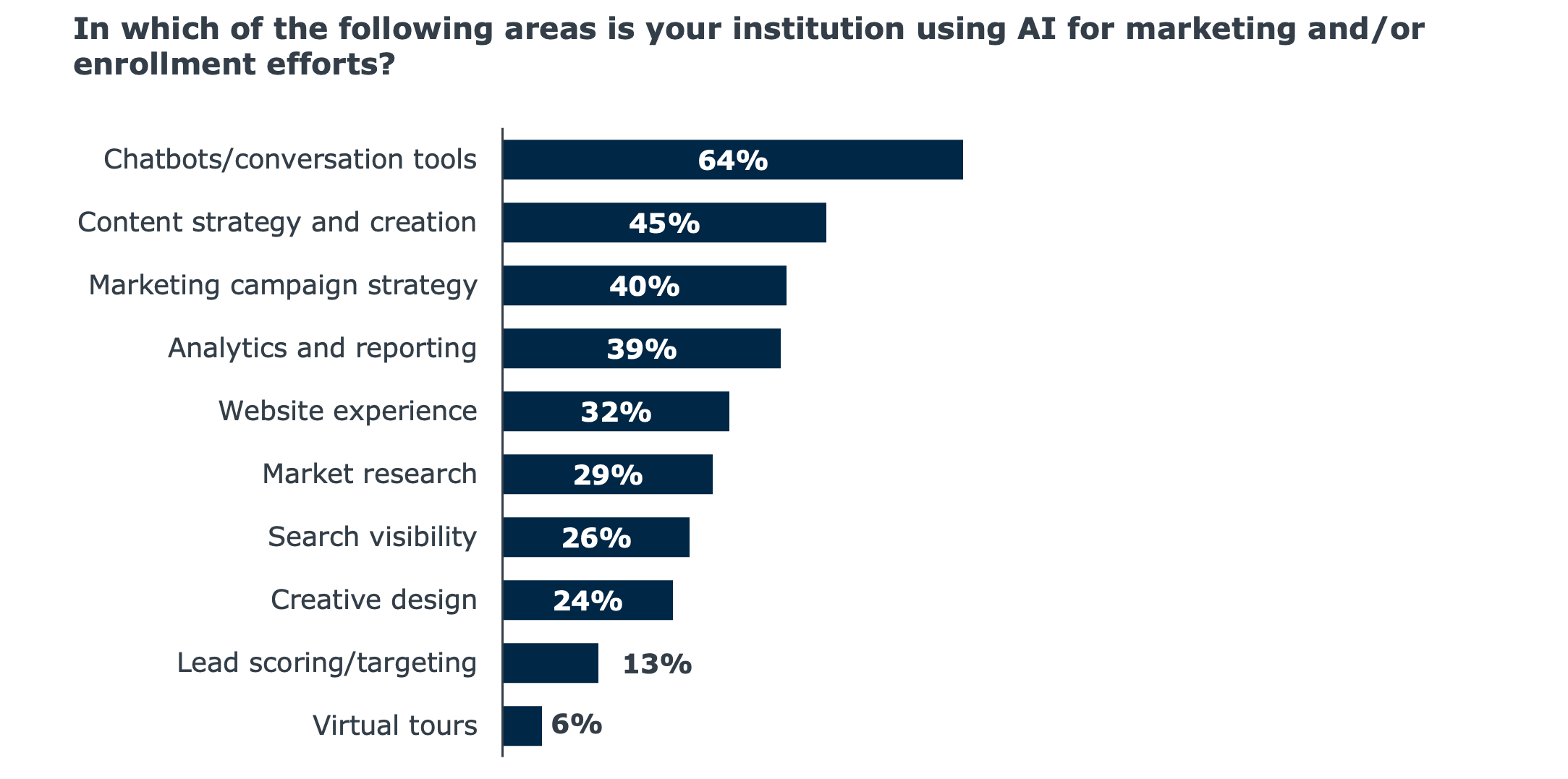
Respondents also see additional use cases for AI in graduate enrollment marketing. Surveyed enrollment leaders identify the potential for AI to draft content for recruitment communications, mine enrollment data for insights, and power “next-gen” chat agents more effectively as the most compelling future use cases.
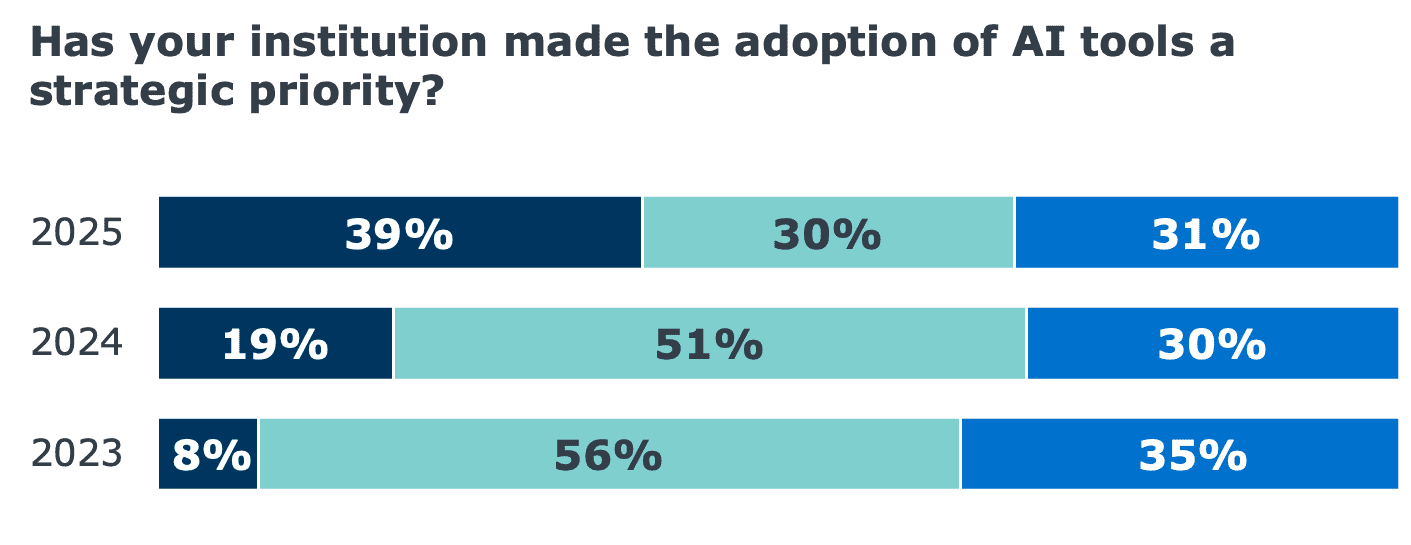
However, at many institutions, AI adoption may still depend on broader institutional priorities. Only 39% of respondents say that their institution has made the adoption of AI tools a strategic priority—although that number has risen dramatically since 2023.
2. Enrollment leaders aren’t confident in how their programs show up in AI search
Students’ use of AI search engines to find and compare programs is perhaps the biggest change to hit enrollment marketing in years. In our survey last fall, 46% of students said they are using AI to search for college options. By now, I expect that number is much higher.
The result: Students are making decisions about your grad programs without ever visiting your website. Organic traffic to university sites has declined by 53% on average, according to Hybrid experts. If your programs aren’t showing up in AI search results—such as a Google AI Overview or ChatGPT responses—they may be invisible to a large portion of the market.
Nearly one in three surveyed enrollment leaders said they are not confident their institution appears in AI search. And it’s not enough to simply have your program or institution appear in AI search results. As my teammate Emily Upton wrote, not all mentions in AI search are positive. Does the mention in AI search accurately reflect your program? Does it represent your program positively?
3. Enrollment leaders are more concerned about AI risk than adoption
When we asked enrollment leaders about their concerns around AI in previous years, most cited barriers to getting started, such as the cost of tools and training, and the competitive disadvantage at institutions with fewer resources to devote to AI.
But now, enrollment leaders are more focused on the risks associated with AI use. These include:
- Mistakes or AI “hallucinations”
- Integrity of student applications
- AI inadvertently sharing proprietary and/or personal information
These findings underscore that AI has become a more widely used tool in graduate enrollment offices. Still, there’s room for enrollment teams to use AI more effectively to personalize marketing messages, improve student engagement through chat agents, and analyze enrollment trends. There’s also a growing need to meet students on AI search platforms. Enrollment teams will need strategies not only to appear in AI search results, but also to ensure those results accurately and positively represent their graduate offerings.

More Blogs

How mature is your AI search strategy?

4 steps to ensure your .edu remains the trusted source for students—and AI