How adult degree completers are rethinking their college search
If you’re looking to grow enrollment among adult degree completers, understanding how these prospective students search for and choose programs is critical. Adult degree completers are moving through the enrollment funnel faster, researching more independently, and weighing cost and value even more carefully than they have in the past. To better understand these shifts, EAB surveyed more than 8,000 graduate and adult learners about their motivations, search behaviors, and enrollment decision-making.
Below are four key findings from the 2025 Adult Learner Survey that are especially relevant for institutions recruiting adult degree completers, as well as what they mean for your marketing, messaging, and engagement strategies.
1. Adult degree completers’ journeys are short—and getting shorter.
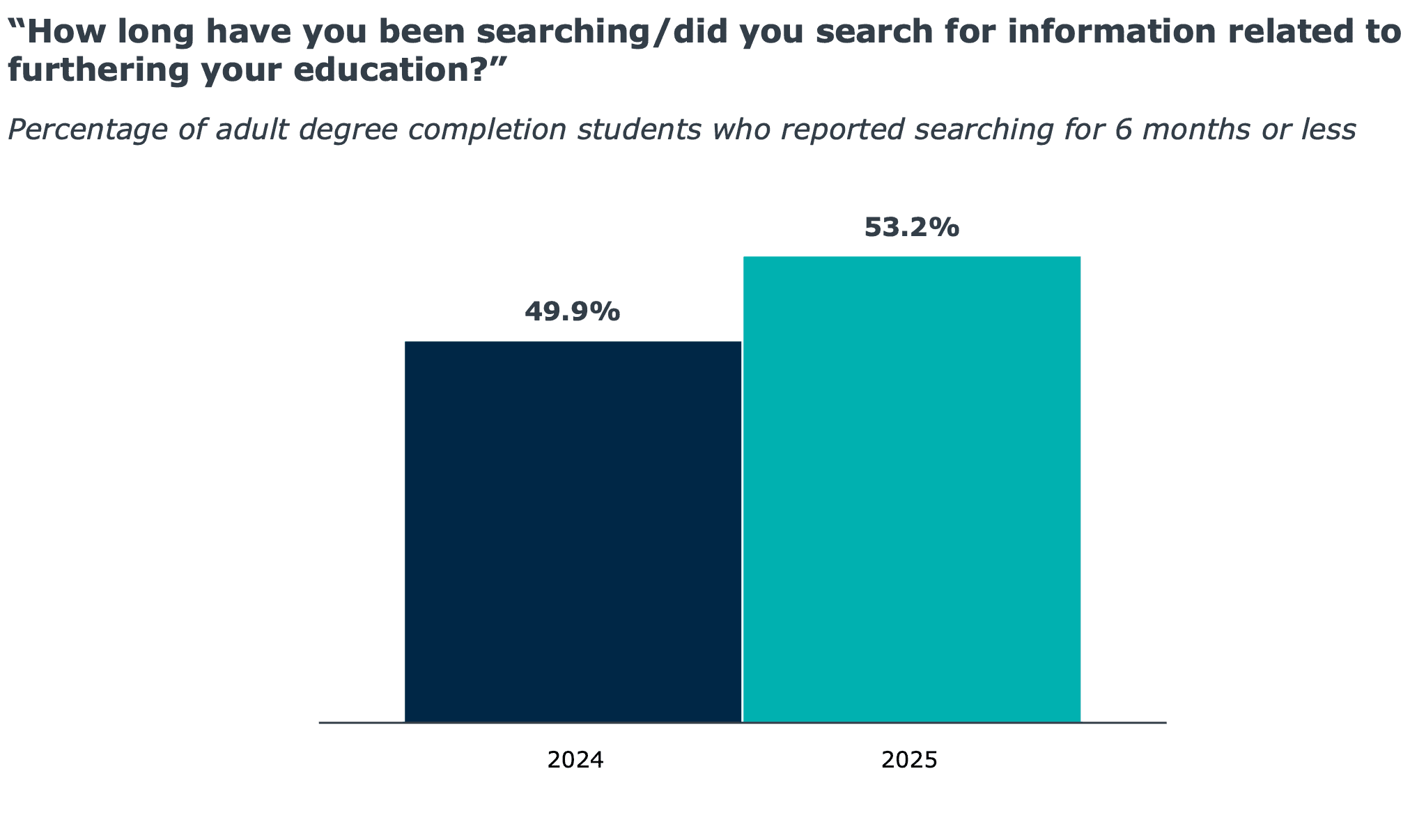
More than half of adult degree completers report that their college search lasts six months or less, continuing a trend toward more efficient decision-making. Compared to prior years, a rising number of these students are moving quickly from initial research to enrollment decisions. While the increase itself isn’t drastic, the trend is worth monitoring. This compressed timeline raises the stakes for institutions to make a strong impression early in the search process, then keep students’ interest through their journeys. Building a strong full-funnel marketing strategy helps to ensure you meet students where they are at any stage of their program search.
However, this isn’t the full story. On the other end of the spectrum, more than a quarter of adult degree completers say their search lasts a year or longer. These students may pause and reengage as personal, professional, or financial circumstances change. Together, these trends highlight the need for engagement and nurture strategies that can respond quickly to near-intent leads while remaining visible and relevant for those with longer decision cycles.
2. One-fifth use AI-generated web results in their college search.
AI-powered search tools are becoming a meaningful part of how adult degree completers research programs. Use of AI tools for program research increased fivefold between 2024 and 2025, rising from just 3.5% of surveyed learners to nearly 20%. In a search environment increasingly shaped by “zero-click” results, these early touchpoints can make or break a student’s impression of your institution.
AI is also exacerbating a familiar behavior: stealth shopping. Adult degree completers often prioritize speed and convenience, using AI tools to compare programs, estimate costs, and narrow options without sharing personal information. For institutions, this makes providing clear and up-to-date information on your .edu site—especially around cost, time to completion, and outcomes—essential for staying visible and competitive in AI-powered search results. Incorporating lead sources that aren’t impacted by the influence of AI, such as Appily Advance, will also help shore up your strategy against a potential loss in search visibility.
3. Cost remains a major consideration in their program decisions.
-


$15K
55% of adult degree completers are unwilling to spend over $15,000 per year on their education.
Affordability is still one of the most influential factors in adult degree completers’ enrollment decisions. Over half are unwilling to spend more than $15,000 per year on their education, and over 60% expect to rely on financial aid to afford their degree. Even highly motivated students are likely to remove programs from consideration if costs feel unclear or out of reach.
These findings reinforce the importance of transparency. Tuition, fees, and financial aid options should be easy to find and simple to understand on your .edu site. When cost information is paired with clear explanations of program value, such as time to completion, outcomes, or career relevance, adult degree completers are better equipped to assess whether a program fits both their goals and their budgets.
4. Their primary reasons for returning to the classroom are more passion-driven than pragmatic.
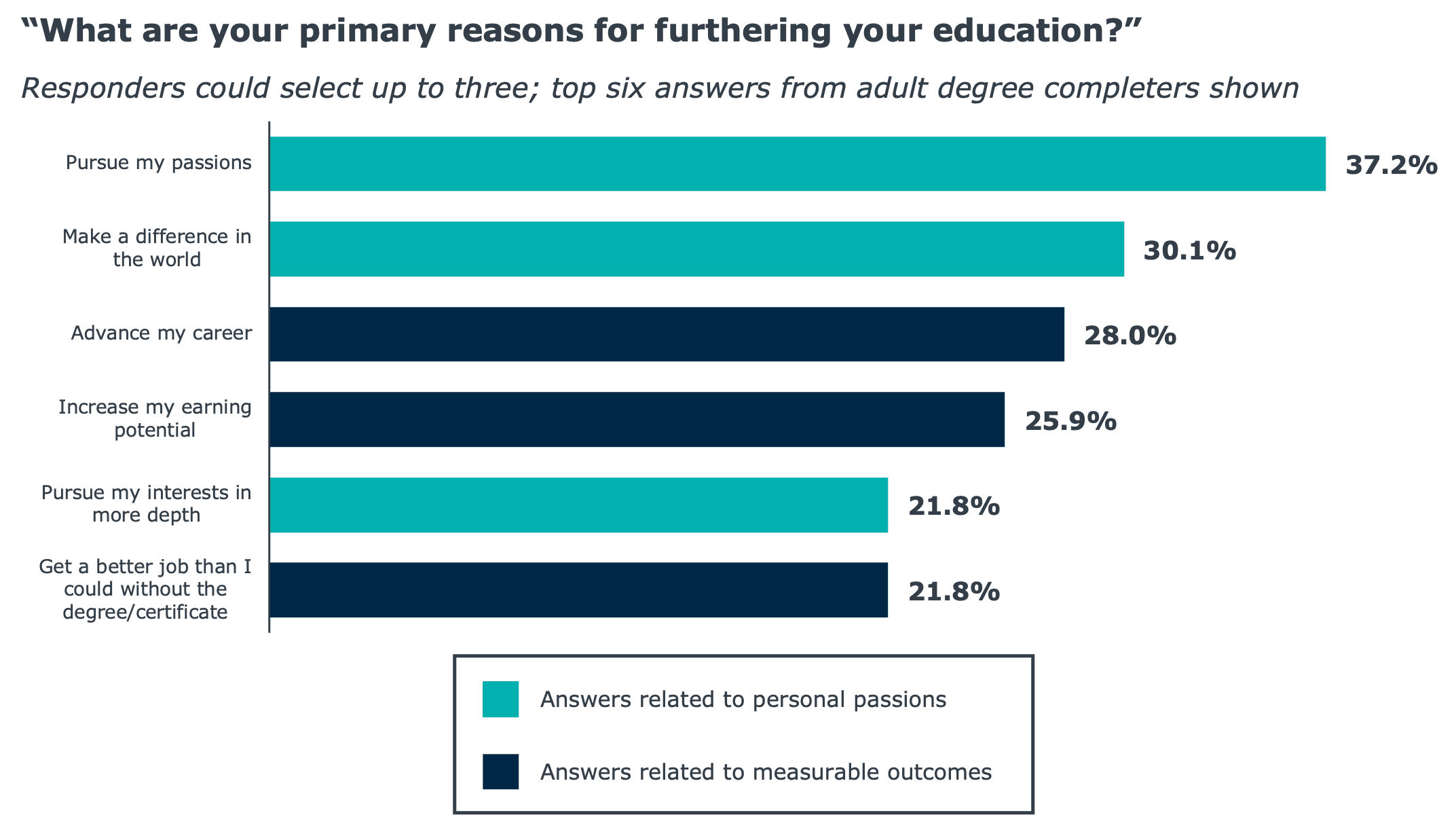
While cost and ROI matter, many adult degree completers are motivated by goals that extend beyond just career advancement. Nearly two-thirds cite pursuing their passions or wanting to make a difference in the world as primary reasons for returning to school. These motivations reflect a desire for meaning, impact, and alignment with personal values.
To resonate with this audience, institutions should balance practical information with social proof messaging that highlights purpose and fulfillment. Alumni stories, student testimonials, and examples of real-world impact help prospective degree completers envision themselves in a program. When combined with clear cost and quality signals, this type of social proof strengthens a value proposition that feels both rational and deeply personal.
Together, these findings paint a clear picture of how adult degree completers are navigating the enrollment journey today. Students are deciding a bit faster, researching more independently, relying on AI-powered tools, and placing greater emphasis on affordability and personal relevance. While technologies and behaviors will continue to evolve, institutions that deliver clear, timely, and student-centered information across channels will continue to be best positioned to engage and enroll this growing population.

More Blogs

Marketing teams are stretched thin. Here’s what the data says to do next.

4 key trends shaping graduate business enrollment in 2026