How to diversify and shield your graduate lead generation efforts in the AI era
When AI large language models (LLMs) like ChatGPT and Claude entered the mainstream, marketing and enrollment leaders quickly began asking themselves: How will AI affect organic traffic? Will students stop clicking on our paid ads?
But the introduction of AI is also exposing an existing problem among enrollment marketers: a dependence on too few lead sources, such as organic search or paid advertising, for too many leads. When your lead generation strategy is dominated by only a few channels, it’s more vulnerable to market shifts like international turmoil and AI disruption.
Here are three steps enrollment and marketing leaders can take to strengthen their pipeline and reduce their dependence on any single source of demand.
1. Assess your visibility and lead risk
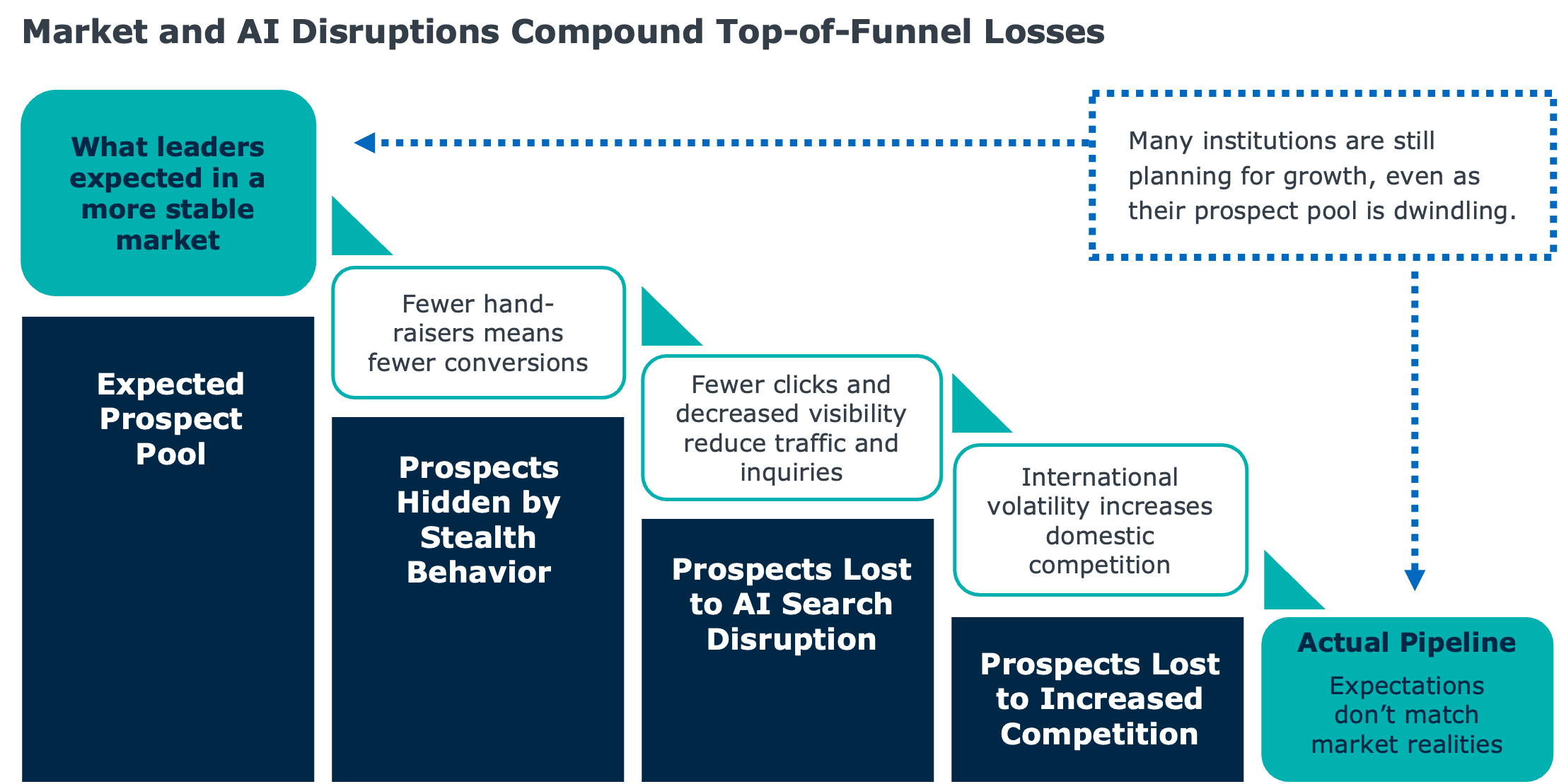
Before adjusting your current strategy, it’s important to understand where your pipeline is most exposed. Today’s enrollment environment is facing pressure from multiple directions. International enrollment declined 17% from 2024 to 2025, intensifying competition for domestic graduate students. On top of this, AI has reshaped search behavior and top-of-funnel visibility, making traditional indicators of demand less reliable. This has amplified an already stealthy market, making it harder to identify early-stage interest. Now, many enrollment teams have less visibility into prospective student behavior than they did even a few years ago.
-


-17%
Decline in new international graduate enrollment from 2024 to 2025
To understand your visibility and lead risk, consider conducting a self-assessment. Alongside your team, ask discovery-based questions about:
- AI visibility: Are your priority graduate programs appearing accurately in AI-generated search results and answer engines?
- Channel concentration: Does a single source account for the majority of your lead volume? What would happen if performance dropped suddenly?
- Performance indicators: Can you confidently connect marketing activity to applications and enrollment outcomes, or are you relying primarily on inquiries and clicks?
- Capacity to adapt: Does your team have the expertise and bandwidth to respond quickly as search behavior and discovery channels continue to evolve?
Your answers can help you evaluate your ability to continue generating leads if and when market conditions change.
2. Diversify how you generate leads
One mistake enrollment leaders can make is responding to AI disruption by investing more heavily in the same channels they are already using. Search remains an important lead gen tactic, but it has become less reliable. AI Overviews, rising advertising costs, and increasing competition mean institutions may need to work harder for fewer clicks and inquiries.
-
-53%
Decline in organic traffic to university websites from 2023 to 2025
A resilient lead generation strategy includes multiple pathways for prospective students to discover and engage with your institution. That means protecting visibility across core search channels, expanding demand beyond search-dependent tactics, reducing overreliance on any single lead source, and evaluating channels based on student fit and enrollment outcomes. It’s also important to prioritize channels that verify student intent, such as Appily Advance, to strengthen the quality of your top-of-funnel.
EAB recommends that no single channel account for more than 50-60% of total lead volume. When one source dominates your pipeline, even small shifts in search behavior, competition, or advertising costs can have an outsized impact on enrollment results.
3. Track results and sustain performance
-
-53%
Decline in organic traffic to university websites from 2023 to 2025
A “set it and forget it” approach won’t withstand today’s fast-moving and ever-changing student search process. As AI continues to reshape student discovery, enrollment leaders will need to regularly evaluate performance and adjust their approach.
As search behavior evolves, traditional marketing metrics become less reliable indicators of enrollment success. When AI-generated summaries appear in search results, click-through rates can decline by as much as 60%, making it increasingly important to look beyond clicks, inquiry volume, and cost per lead when evaluating performance.
To sustain performance over time, enrollment leaders should focus on three areas:
- Shift from channel metrics to enrollment outcomes. Track lead performance through application, admit, and yield. Understanding which channels contribute to enrollment outcomes can help guide smarter budget decisions.
- Review and adjust your strategy regularly. Messaging, segmentation, channel mix, and timing should be evaluated on an ongoing basis. What worked a year ago may not perform the same way today, particularly as AI continues to influence student discovery behavior.
- Build the capacity to adapt. Whether through internal expertise or external partnerships, institutions need the ability to monitor shifts in AI search, emerging channels, and changing student behavior so they can respond quickly when conditions change.
The strongest pipelines are diverse enough to withstand disruption
AI is changing how students discover and evaluate graduate programs, but it’s also revealing weaknesses that existed long before LLMs entered the picture. The institutions that thrive in the years ahead will be the ones that understand their risks, diversify their demand sources, prioritize high-intent leads, and continually adapt as the market evolves.

More Blogs

The “4S” challenges reshaping graduate and adult enrollment

How mature is your AI search strategy?