The enrollment game has changed. What still works?
I had a life-lesson moment with my kids earlier this year during a family debate about how upset you should be at losing a game of bingo versus losing a game of basketball. As we all know, bingo is a game of chance for which practice and skill have little influence. By contrast, in basketball, the conditions and competition may change, but strong fundamentals will contribute to the outcome.
This got me thinking about enrollment. So many events in the enrollment universe across the past few years feel like new additions to a bingo card where luck is your only friend, versus a basketball game where the players have changed but the fundamentals can still find you the W.
Enrollment leaders know this, of course. But when students are searching differently, families are asking harder questions about value, competition is intensifying, and AI is reshaping how information reaches prospective students, it’s easy to get caught up in reacting to whatever comes next. Sometimes it helps to pause and take a look at what we can control.
Drawing on our most popular enrollment research, the 14 strategies in this post make up the fundamentals that still deliver results, even as the market changes.
Understanding your market, peers, and competitors
Strategy 1: Look beyond traditional peer groups to identify your true competitors
Our research shows that students do not always compare colleges based on the categories institutions use to define themselves. Schools that look very different on paper may compete for the same students because they offer similar experiences, outcomes, or attributes. Our analysis of how students actually group and compare institutions is a useful reminder to pressure-test traditional peer sets against real student choice behavior.









Strategy 2: Build a practical competitive intelligence habit
Competitive intelligence comes up in a lot of my conversations with enrollment leaders. Everyone sees the value, but finding time to do it consistently is another story. The simple, repeatable approaches outlined in this research can help: focus on the competitor changes most likely to influence student choice, such as programs, pricing, messaging, market expansion, and recruitment activity. That gives your team a better chance of noticing what requires a response without trying to track everything happening in the market.
Strategy 3: Let student travel patterns guide your recruitment
Eighty-four percent of states saw an increase in the number of students traveling at least 500 miles to attend college from 2020 to 2024. That’s a good reason to question old assumptions about how far students are willing to go. Before investing more in a geographic market, compare current mobility patterns with your own inquiry, application, and enrollment data. It can help you focus your recruitment effort on genuine opportunities, rather than places that simply look promising on a map.
Strategy 4: Use evidence of student fit to prioritize new markets
New market planning should start with more than population projections. Before committing significant resources, look for evidence that students in a market are already showing interest in your institution or in institutions with a similar profile.
Historical performance, peer-institution interest, student preferences, and search behavior can reveal markets where your institution already has signs of fit. Those signals give your team a stronger starting point than a broad demographic opportunity alone.
Strategy 5: Anticipate the tradeoffs behind your enrollment goals
Enrollment leaders are under enormous pressure to improve several outcomes at once: admit rate, yield, discount rate, headcount, and net tuition revenue. That’s a lot to carry, and our analysis shows how difficult it is to move one metric without affecting another. Looking at these goals together can help leaders make clearer tradeoffs, understand the broader impact of each decision, and contextualize those considerations for cabinets and boards.
Strategy 6: Use your peers’ priorities to inform your next moves
Enrollment leaders are often responding to the same market pressures, even if those pressures show up differently at each institution. When certain priorities begin appearing across campuses, whether around affordability, staffing, digital engagement, or technology, they can offer an early indication of where the market is headed. Following those patterns can help your team anticipate what may demand more attention next, before it becomes an immediate concern.
Building an adaptable recruitment ecosystem
Strategy 7: Connect the student experience across channels
Your team may think about search, email, events, the website, and counselor outreach as separate parts of the plan, but students don’t. For them, it’s all one experience with your institution. They might find you in a search result, open an email a few days later, attend an event, and eventually talk with a counselor. And ideally, each interaction picks up where the last one left off. Connecting your platforms makes that easier, while also giving your team a clearer view of what’s actually working.
Strategy 8: Measure the combined influence of recruitment touchpoints
Although many schools use first-source attribution, that approach tells only part of the story. Lists, platforms, direct marketing, events, and digital experiences often reinforce one another before a student applies or enrolls. Looking at recruitment through a multi-source lens can give teams a better view of which combinations of interactions are influencing student behavior.
Strategy 9: Strengthen the digital channels students rely on
Students can encounter your institution in many digital environments before they ever submit an inquiry. Your website, search presence, outreach, virtual tours, social channels, and third-party platforms should work together to make information easy to find and act on. As student behavior changes, periodically reassess which digital channels deserve the most attention.
Strategy 10: Offer students digital experiences that can evolve with their expectations
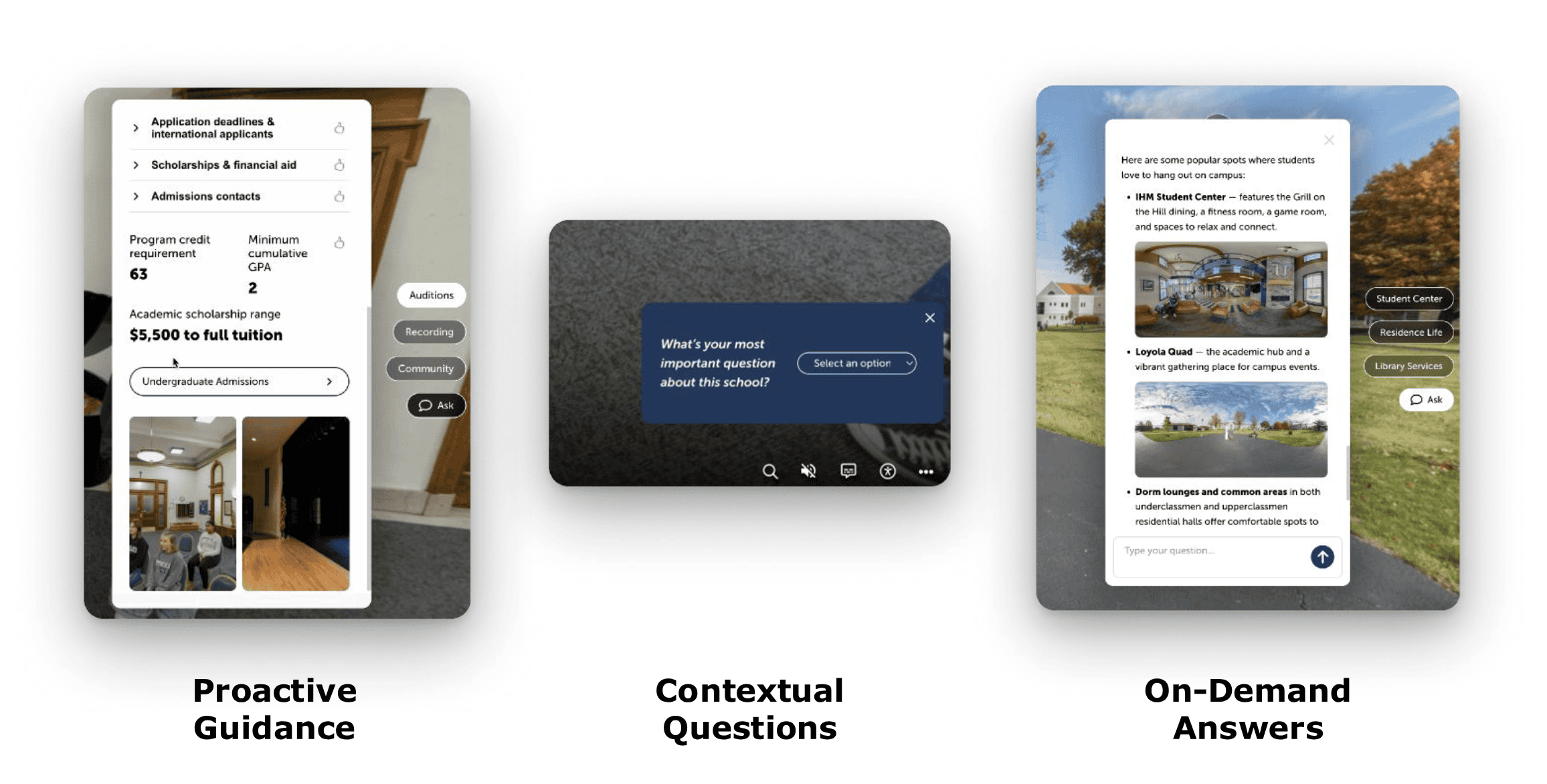
Technology investments should leave room for the student experience to improve as behaviors change. Virtual tours are one example. Tools such as Appily Tours’ AI Tour Navigator can make an established recruitment channel more responsive to individual student questions and interests, extending its usefulness as college search evolves.
Three engagement modes in AI Tour Navigator from Appily Tours
Strategy 11: Design your emails for an AI-mediated search experience
AI is increasingly influencing what prospective students see, how information gets summarized, and which next steps rise to the top. Enrollment teams should keep testing how their communications perform in those environments. Our experiments with AI-powered inboxes reinforced the importance of fundamentals such as clear deadlines, explicit next steps, and content that remains understandable when an AI tool summarizes it.
Shaping consideration and sustaining student commitment
Strategy 12: Bring parents into recruitment early
Parents and families have a lot of influence over college decisions, especially when questions about cost, value, safety, and student well-being come up. And they want to hear from institutions. 74% of parents who participated in our latest parent engagement survey indicated that they’re highly involved in their students’ college search process. Reaching families early gives them better information to support students and helps keep everyone on the same page as decisions get closer.
Strategy 13: Plan for a longer senior-year decision window
If it feels harder than ever to tell where your class is headed, there’s a reason for that. Students are applying to more colleges and keeping more options open later into senior year. EAB’s survey of more than 9,500 students found that the average number of applications rose from 6.1 to 7.1 in just four years. That makes every application, admit, or even deposit feel a little less reassuring than it once did. The best response is to keep earning students’ attention throughout senior year with communication that feels personal, helpful, and genuinely useful as they weigh their choices.
Strategy 14: Manage yield across the full recruitment funnel
Yield strategy begins well before students receive their acceptances. Early outreach and sustained engagement give students more time to understand your institution, build affinity, and picture themselves on campus. In practice, that means yield management should start near the top of the recruitment funnel, not only after admission decisions go out.
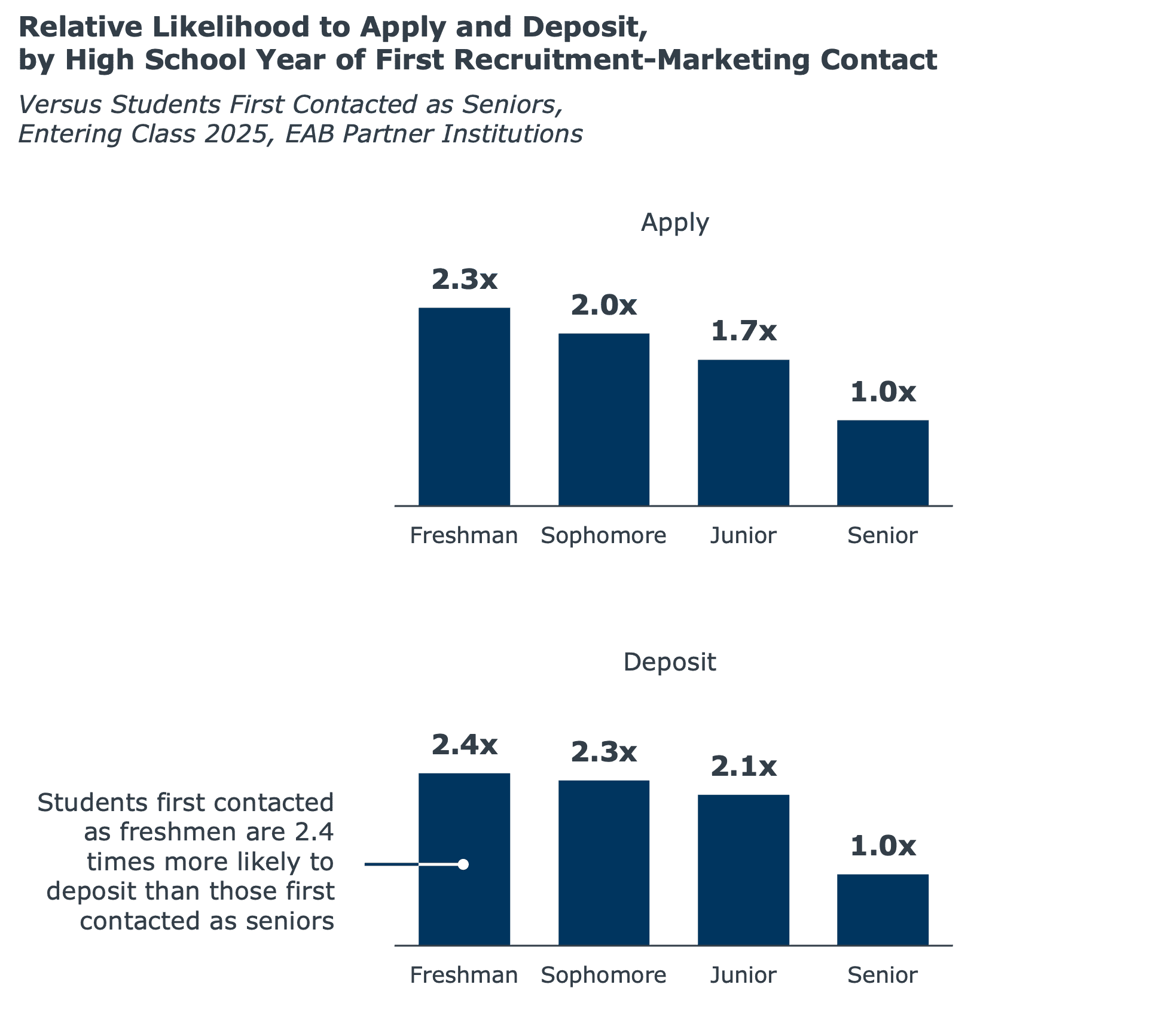
Institutions can use this earlier window to identify students who show meaningful interest, tailor communications to their priorities, and address questions or concerns before they become barriers to enrollment. By the time admission decisions are released, students should already have a clear sense of what makes the institution a strong fit and what their next steps would look like.

More Blogs

How mature is your AI search strategy?

4 steps to ensure your .edu remains the trusted source for students—and AI